There are many ways to grab the player’s attention, without actually using the HUD
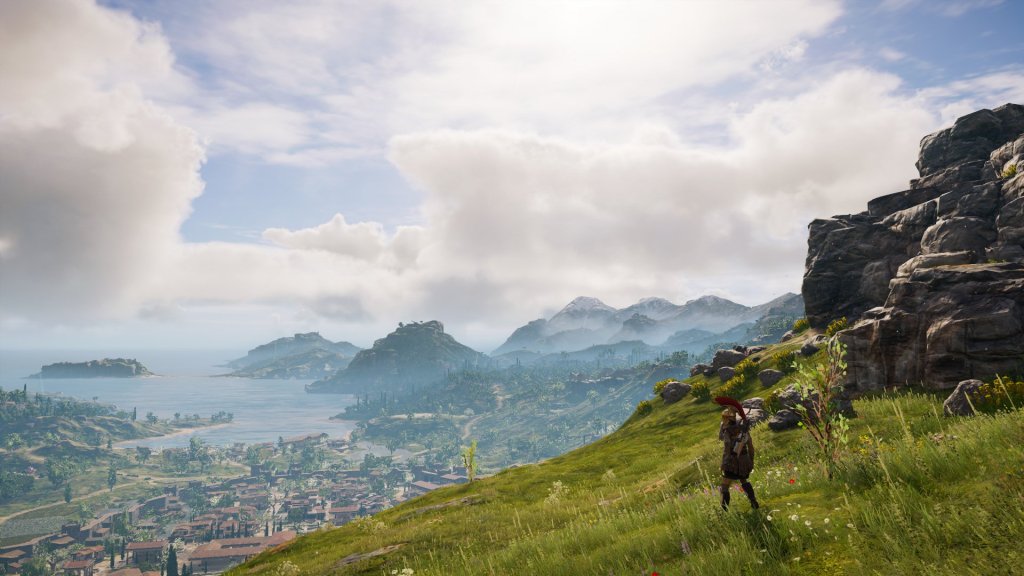
Arguably, the game’s forte is a genuinely picturesque depiction of ancient Greece, which presents massive potential to generate wonder through exploration – those “wow” moments games can evoke through spectacle (think The Last of Us giraffes). The way the game directs the player takes away all of this. Having us venture into the wilderness with a pointer – ‘your target is North of the Athens theatre’ – is a good start, but problems arise hereafter. The player is encouraged to use their pointer to mark a spot on the map which roughly represents where they need to go, and the quickest way to reach that marker is to have your horse ride there autonomously. When the horse gets near-ish to the destination, an instruction to begin the eagle searching minigame takes centre screen, such that it isn’t viable to ignore it. This minigame is the worst phase of the loop. To pinpoint the location of whatever we seek, we adopt a bird’s eye perspective, and glaze over the area, panning in whichever direction tightens a ring, until it suddenly marks the target and most of the enemies around it. Now that a new marker has been set, we run or ride towards it, until we arrive, and do whatever we needed to do there. Now, consider the player’s focus through that gameplay loop: setting a marker via a menu, allowing the game to take them to the marker, panning the camera to tighten a disk, running towards a new marker, then performing the activity. For far too much of this, the player is focused on the HUD, not the world! The best example is the Ikaros game – we should be paying attention to the world, looking for an enemy, or an item we need to steal, not the fluctuations of a yellow ring.
I have no doubt that this game could generate wonder with some better systems in place, because it already has for me. When I almost entirely turned off the HUD, and just explored, I was not disappointed, however to play Odyssey in this state without the HUD is only viable if you merely wish to stumble across objects of interest – you can’t actually play most of the content whilst neglecting the HUD, because you are lacking direction. All we need therefore, is a way to direct the player, without taking their eye off of the world.
Here’s how the gameplay loop could be revised to shift the player’s focus to what matters: direct the player ‘North of Athens theatre’, to look for ‘the building with the red door’ (for example). Now searching for a location involves actually searching for a location, as we will have to look around us, and take the world in as we scan for a distinctive feature, instead of simply playing a minigame. Through that process of taking things in, in a world like Odyssey’s, those moments of spectacle would start to appear with some regularity.
Of course, designers should be wary not to make the majority of destinations too hard to find through this system, as nobody wants to fruitlessly run back and forth through areas due to the obscurity of what they seek. I would imagine a conventional mode where objectives are marked on the HUD could co-exist with this mode, much like they offered two unfortunately equally poor systems in this game, to allow people to play the old style, should they want to.
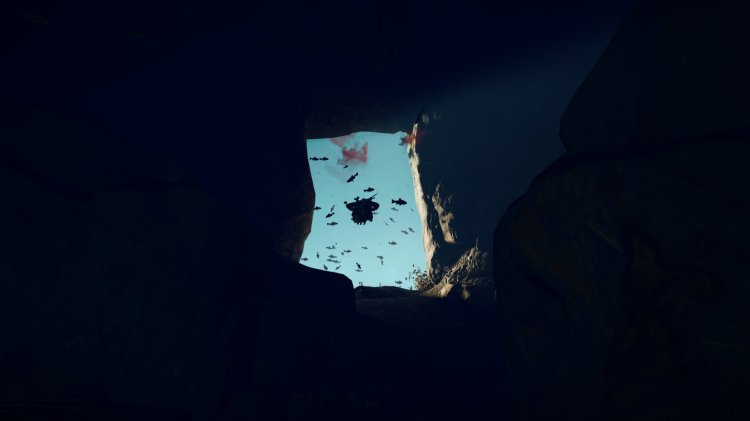
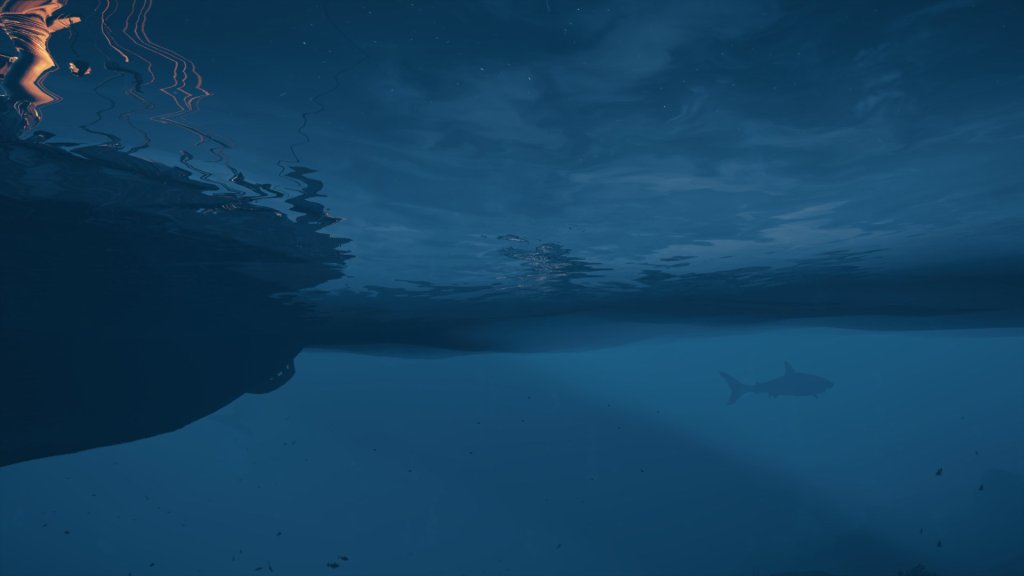
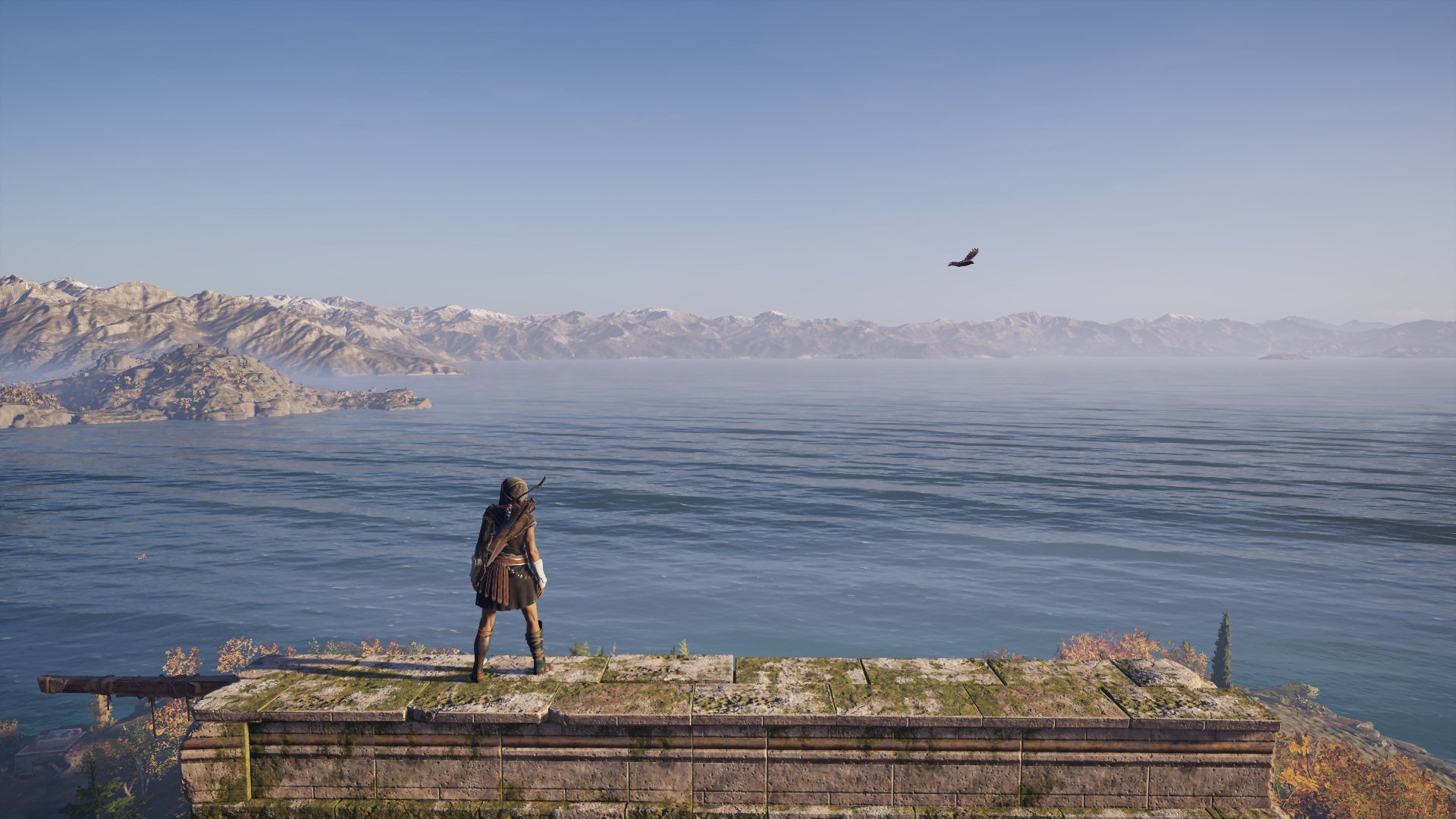
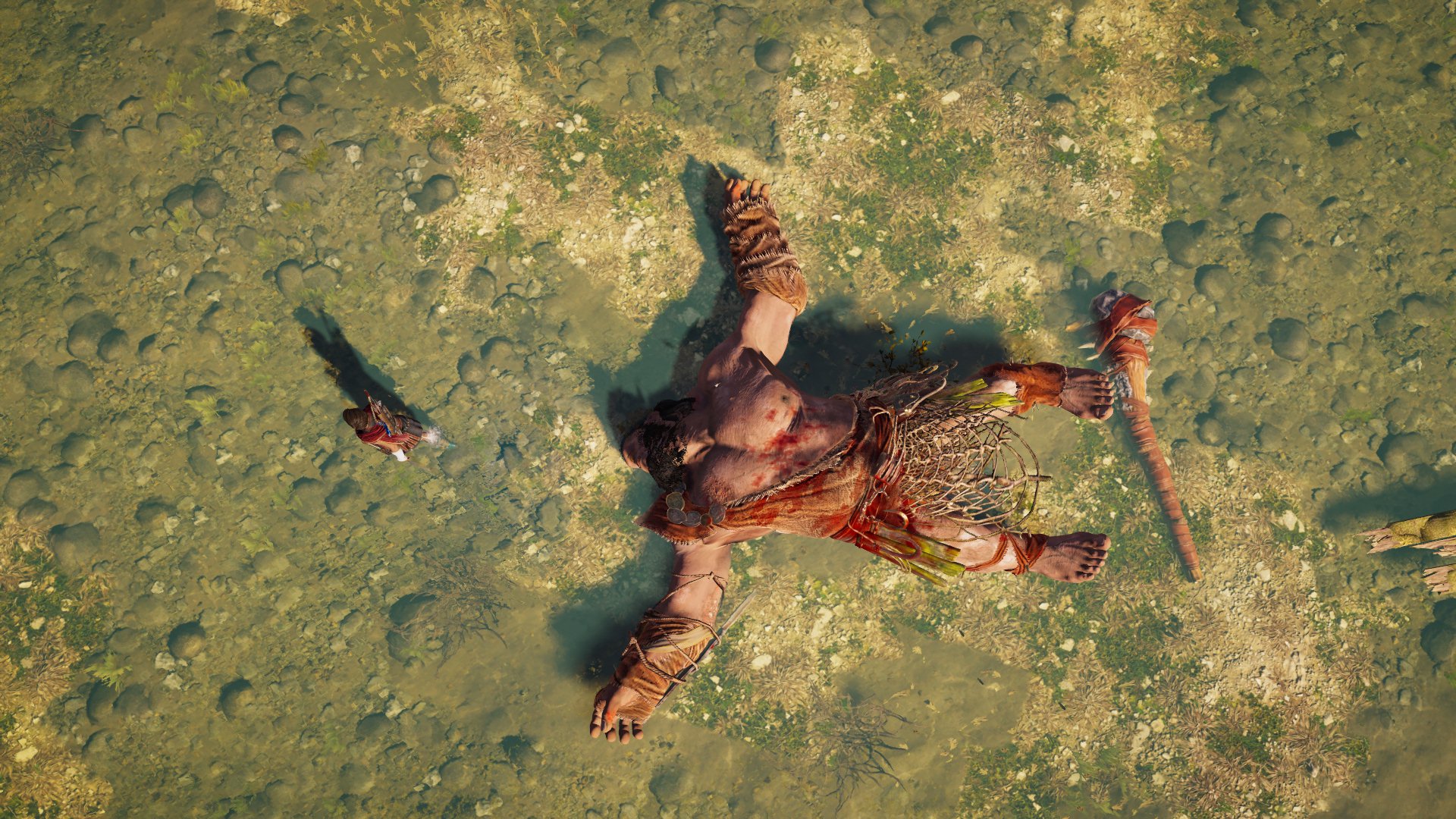
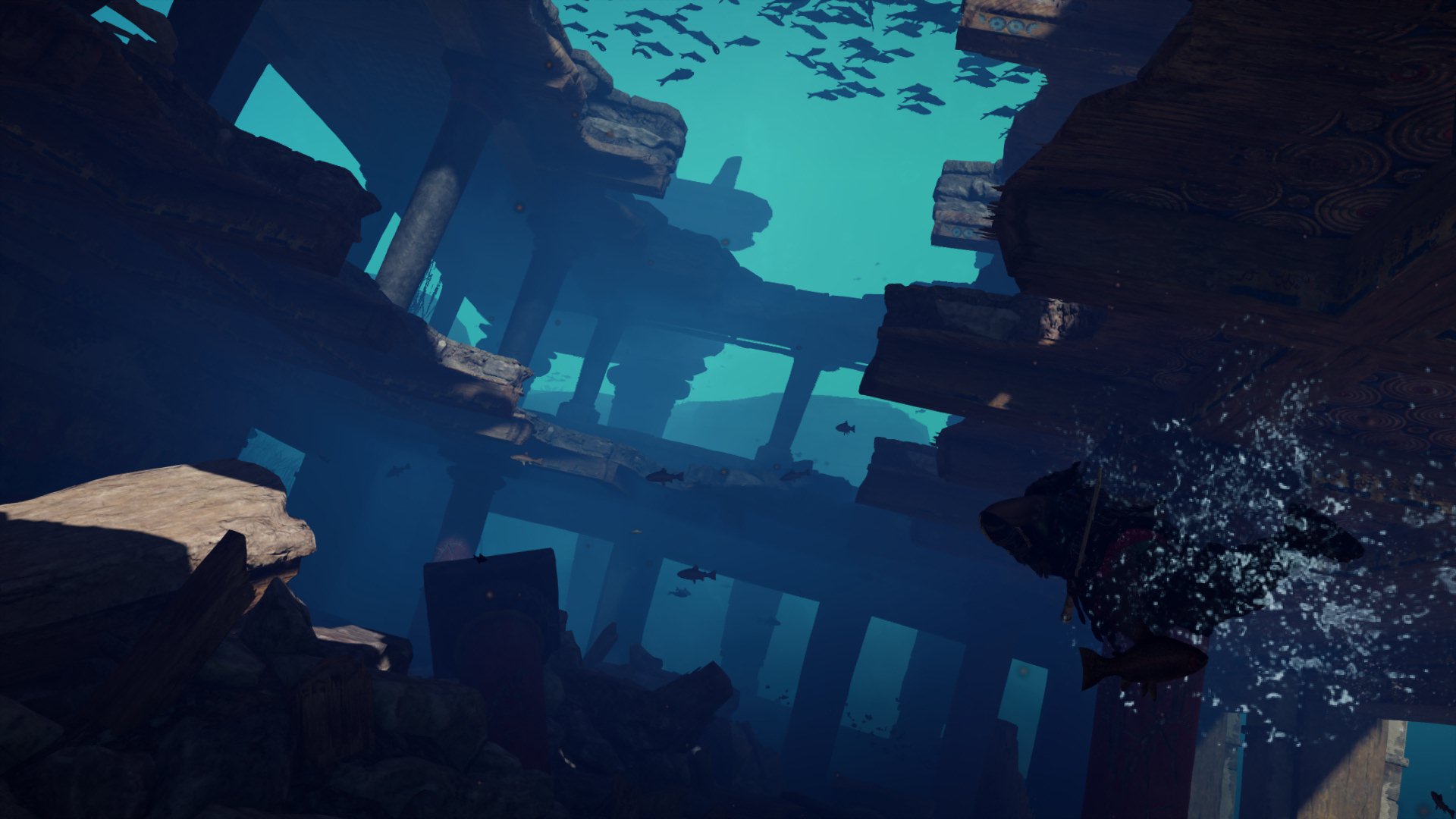
A moment like this is far better than having everything below the water marked out for me by Ikaros
I would also like to see the birds eye view completely removed, as I think it would organically encourage players to seek vantage points, which has been a classic part of the series in the past. A short term, simpler solution, which could probably be implemented in no time, would be to merely remove the searching minigame’s ability to actually mark targets, which I believe would still cause people to identify the rough area through HUD elements, but then have to pay attention themselves since the object within that area hasn’t had a yellow square pinned to it. Moving the eagle’s role to be more like the birds of Ghost of Tsushima would be a way to pull players towards side quests and points of interest – if there’s something to see, the eagle will get your attention, and if you choose to follow it you will arrive at the location without having seen it before.
To summarise: These worlds have an incredible untapped potential, which could be harnessed through reworking the way players are directed through them, such that their focus remains on their surroundings, instead of their HUD.
If informed prior to playing, that Ubisoft aimed to deliver the strengths of Assassin’s Creed, Skyrim, The Witcher 3 and more in a single experience spanning well over sixty hours, I would’ve assumed they were flying far too close to the sun. It would appear that if Ubi were to retell the tale of Icarus, however, he would have continued to soar. The writing misses few beats throughout the odyssey, despite a lack of precision when it comes to delivering the most important moments. The blend of engaging main story, and contained but no less compelling side quests make this game feel like a more light-hearted Witcher, and that’s a great thing. Sadly, feathers of the gameplay became unstuck. The stealth is passable, the combat is underwhelming outside of some awesome boss encounters, and the gameplay loop is a thoughtlessly designed system where we interact with the HUD far more than the awesomely realised Greek world (though this can be alleviated in a number of ways – see the fleshed out gameplay comments for details). Whilst my comments on the gameplay are scathing, I’ve enjoyed at least eighty hours of Odyssey, and have been entertained all the way: this game deserves swathes of praise.
Story concept1: 10/10
Story execution2: 8/10 (Spoilers within)
Satisfaction through gameplay3: 5/10
World4: 10/10
Immersion through gameplay5: 4/10
(These scores evaluate the main game, and ‘Lost Tales of Greece’ free expansion. I played on discovery mode. I played as Kassandra – the Alexios performance likely differed, for better or worse.)
1Though they overlap, the main story explores three areas: Kassandra’s broken family, the Cult’s grasp of Greece, and the long-lasting significance of the Ancients (cleverly intertwined with Greek mythology). Separately, the side quests serve to enrich the world, make it believable, and to challenge the player on themes not explored by the main stories (Sokrates’ quests are a good example of this). These four ingredients have the potential to create intrigue, to provoke thought, and to be emotionally impactful – for this reason I believe Odyssey is conceptually sublime.
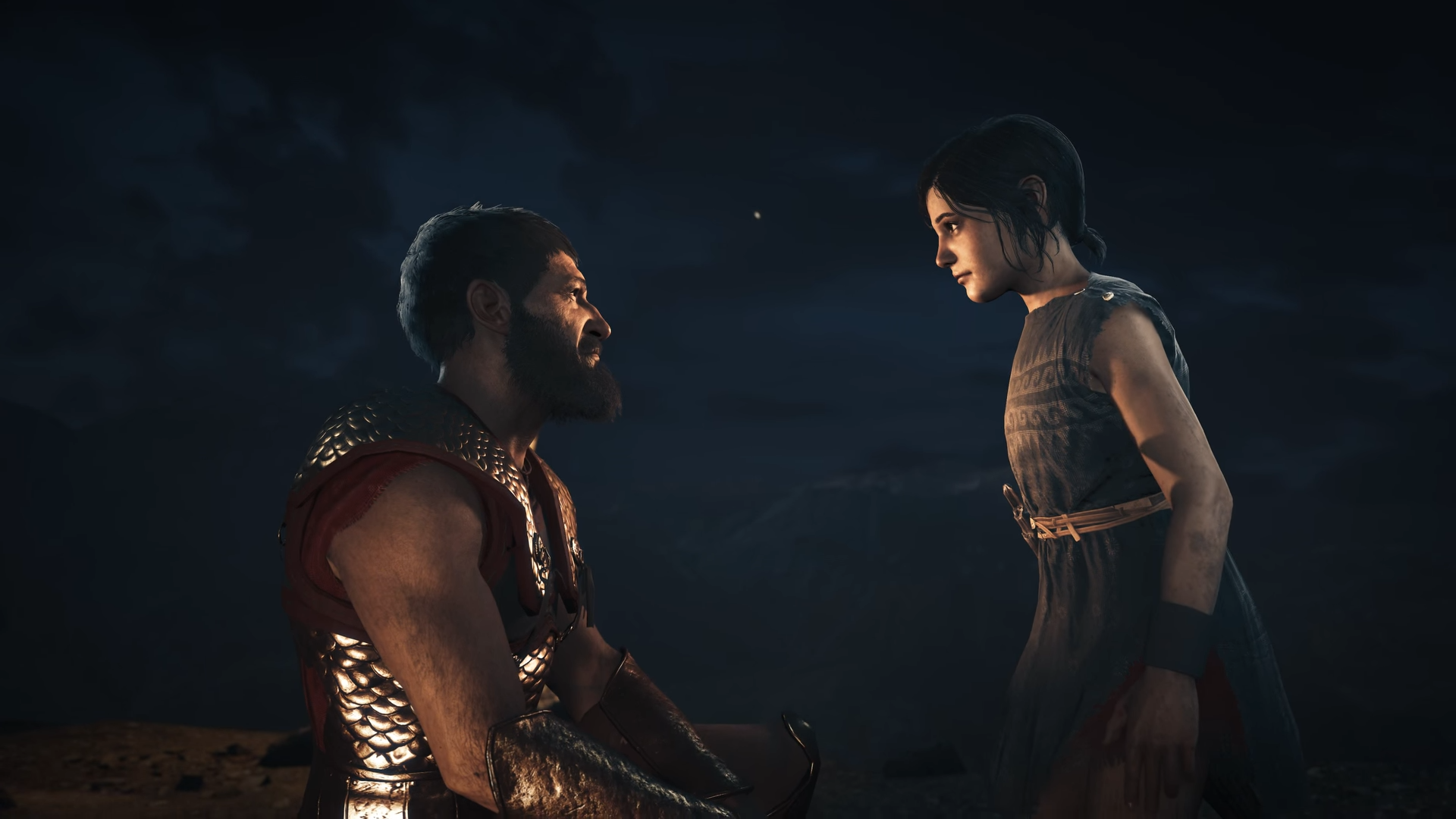
2When it comes to story execution, there are tangible issues with the execution of various story beats, as well as some pacing mishaps, which sadly withhold the fantastic writing from a perfect score. The biggest example of a pacing blunder is the fall of Athens. The cult killing Phoibe and Perikles near simultaneously appeals both to the player’s sense of duty to stop them, as we’ve just seen them achieve a significant milestone in their evil plan, and our emotional desire to stop them, as Phoibe was both one of Kassandra’s truest friends, and a child, however at this stage we have just completed three separate mini stories nowhere near Athens, concerning our long lost mother, meaning by the time we’ve returned we need time to re-acclimatise to everything – instead, after five hours of barely related content, these two hugely significant deaths occur within about fifteen minutes. I would have liked to see an hour or so where Kassandra spent time with Phoibe, having her discuss her new life in Athens, Perikles, and how she thinks maybe something is brewing, to bring the player into the correct headspace before the big moment. My greater gripe lies with the lacklustre execution of some vital story beats, including what I would consider the crux of the game (‘Where it all began’). There are two reasons why the crux fails: a reliance on the limited character expressions available through the dialogue system, and a drop in the writing quality. Understandably, the general dialogue system cannot capture some heightened character emotions adequately. This doesn’t change the fact that many points where expression is crucial are delivered using this inferior system, handicapping them somewhat. When confronting Deimos, most of the scene is carried out through the dialogue system, because player choice is necessary, and yet this means moments like his villainous laughter simply don’t convey what they are supposed to, and serve to de-escalate the situation. This greatly contrasts some other scenes, such as being reunited with Myrinne, which are perfectly executed, and subsequently have the desired effect. As for the writing, being defined as ‘the weapon of the cult’, Deimos’ character until now has been one who has ‘done terrible things’ (understatement), but only because he’s been manipulated to see them as right. Therefore, this should be the moment where you confront the lies he has lived his entire life, reforming his perspective of the world, and causing him to join you (assuming you don’t choose to kill him). Instead, the trigger for him switching sides is merely the fact that Kassandra is unwilling to fight him – when he breaks down, he still seemingly believes that Kassandra threw him off of mount Taygetos in a bid to kill him, that the cult didn’t originally order his death, and probably that Myrinne abandoned him as a child, since when he accuses her of exactly that all she responds with is ‘I loved you’. Some claim when he touches the spear, Deimos sees the truth through visions, and yet the spear never glows or gives sound cues as it does every other time it gives someone a vision throughout the game: if it is in fact the case that Alexios saw the truth through the spear, the lack of any cue identifying that is just as much of an oversight as the truth never being explained to him in the first place. Something of a solution to the former problem could be simple: if no time had been put into having two separate protagonists, and lesser side quests (everything that isn’t an ‘!’ ) surely we could’ve had more accurate dialogue scenes, and a greater number of the bespoke cutscenes. The way the game stumbles at the last hurdle, and some other big points, holds it back from a perfect score, but does not invalidate the fact that the majority is robust.
When extreme expressions are not required the dialogue system is very good. This is proven in the ‘lost tales of Greece’, which possess a heightened level of polish in character interactions which should be strived for over quantity in the future.
The choice-driven path the game sets you down enriches the player’s sense of responsibility during both main quests, and side quests. I have written more extensively about why I think this is a mechanic that adds so much to these experiences in ‘The importance of player choice in The Witcher 3’..
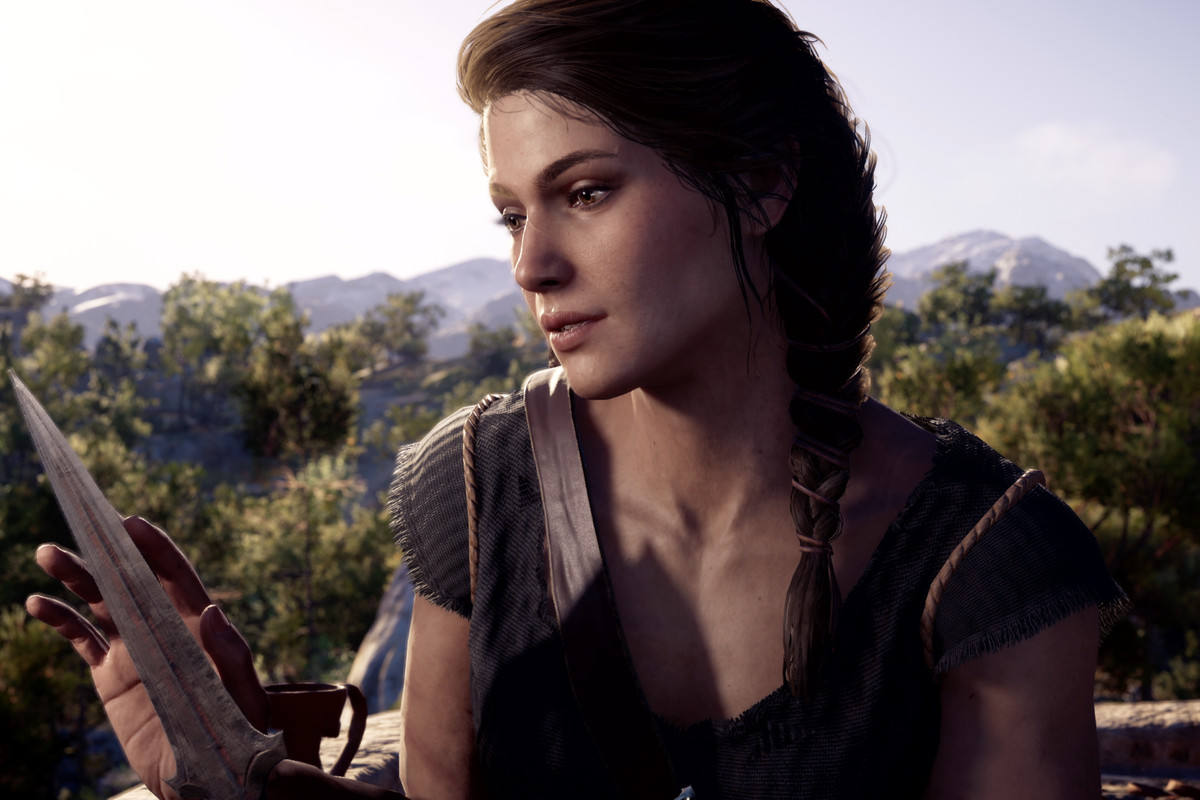
Kassandra was fantastic protagonist. Her openly charismatic nature epitomises the playful feel of Ubisoft’s ancient Greece, and contrasts many of the gruffer leads in other titles without dissipating any tension when stakes are raised. This also benefits from the use of player choice, as it ensures our alignment with the character, and heightens our desire for their success, again, I’ve touched on this elsewhere if you’re interested.
3The way rpg elements have been implemented, along with the combat design, sadly renders the gameplay underwhelming. Odyssey has us design a kit which enables one playstyle, instead of boosting it – if you prioritise stealth abilities, for example, you will be passably powerful at stealth, then unreasonably redundant in combat and at range. This doesn’t match the actual challenges you face in game, as you will be forced into combat no matter how much you focus on stealth. I would argue that if we are to be forced into a situation without notice, we should be equipped to deal with it to the point of adequacy. This combines with the already slow time-to-kill, and generally uninspiring standard fighting to create a real lack of impact – fighting grunts was never difficult, but still felt time consuming, where even my special attacks did negligible damage. At times I would watch as Kassandra ran the spear of Leonidas relentlessly through the chest, neck, and cranium of a grunt, only for him to regain a standardised posture and continue fighting with over half of his health remaining – how empowering. If the challenges posed to us whilst in combat were diverse, I would be more accepting of their drawn out nature, but over ninety percent of combat is best approached by simply dodging, then striking, then repeating, no matter the foe, meaning it feels repetitive and dull. The abilities tree seems to be the way they intended to add thought into the combat, however the number of adrenaline bars the player has access to means we don’t have to be particularly selective about which ability to use, because we have enough adrenaline to just spam them. Perhaps limiting us to three adrenaline bars would improve this, as we then might be so restricted as to have to sacrifice defence for offence, and choose the best form of offence for the foe, since we wouldn’t be equipped to release them at the rate and volume of a belt-fed machine gun. I’d like to highlight the Medusa battle as an example of great combat – there is a method behind the way you have to fight her, and adrenaline has to be built up on the sparingly present mobs, meaning both movement patterns and shot selection must be thought of at all times. For me, the rest of the combat in the game needs either to replicate that degree of necessary player thought, or simply take less time, because its lengthy nature exacerbated what could have been a passable system.
Additionally, the AI needs polish. There’s nothing worse than having an entire city of civilians become hostile to you, because in the process of beheading the source of their oppression, you accidentally nicked their finger – that civilian should’ve sought a bandage, not retribution.
Stealth had the potential to be rewarding – it’s a nice ego boost being told I won’t stand a chance taking on a villain due to how heavily guarded he is, only to avoid his entire guard and erase him with cunning. That said, there is no significant shift in the approach to stealth compared to any past games, and no development as we play, meaning it is familiar from the outset, and stretched to the point where it grows stale. On this topic, I will add that dividing the hunter and assassin stats as drastically as they have results in the bow losing its resourcefulness for those looking to play as an assassin, further restricting gameplay possibilities. Perhaps a perk which limits us to having a quarter of our arrows, but them dealing double damage, would have remedied this.
On a lesser note, a lot of the open world activities didn’t feel justified. The best example of this is probably the conquest battles – whilst they are an interesting change of pace, and do make the world feel more lived in, the game didn’t explore the differences between Sparta and Athens enough to motivate me to fight for either side. Ensuring that each contested region had characters who I knew I would be helping or hurting would’ve really helped motivate me to fight in these battles – have side quests touch on what their rulers have or haven’t done for their regions, allowing us to decide whether or not we want to maintain that system. I appreciate that choosing to fight can be explained as ‘the work of a mercenary’ – these soldiers will die anyway, so why not get paid to kill them – but that isn’t nearly as compelling as knowing that by clearing Sparta out of an area, I will be freeing slaves whose suffering I have already witnessed in a side quest, for example.
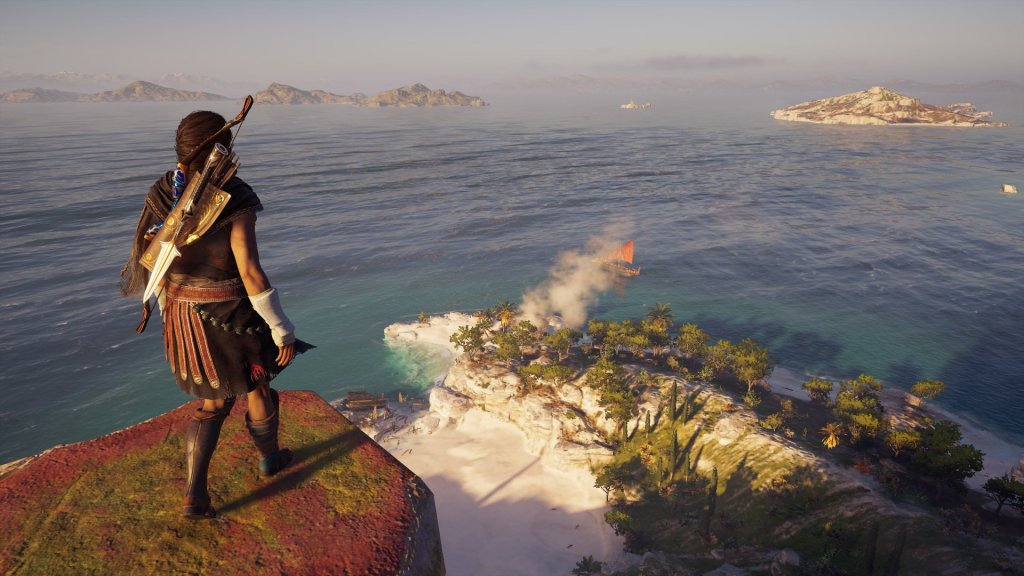
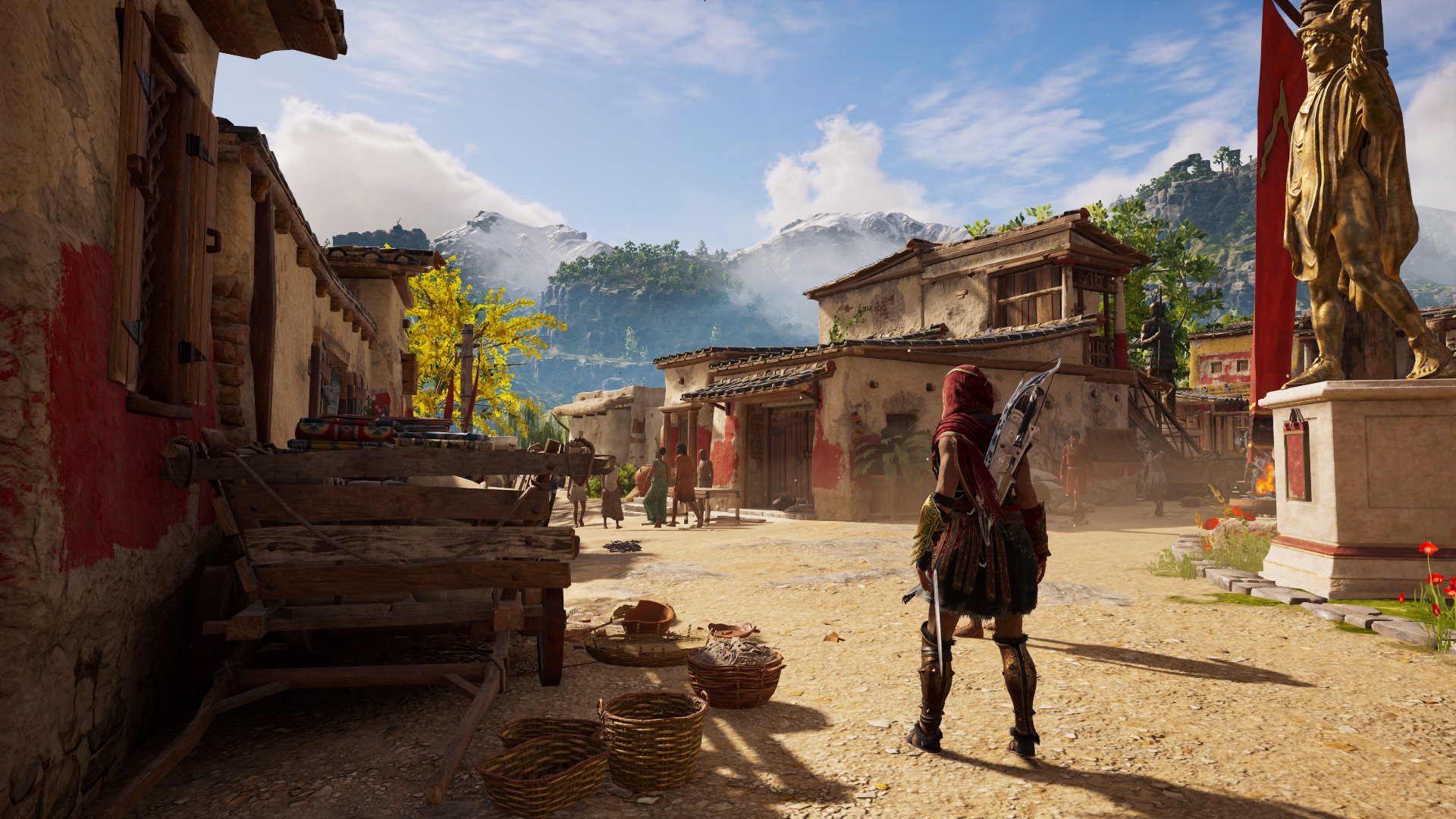
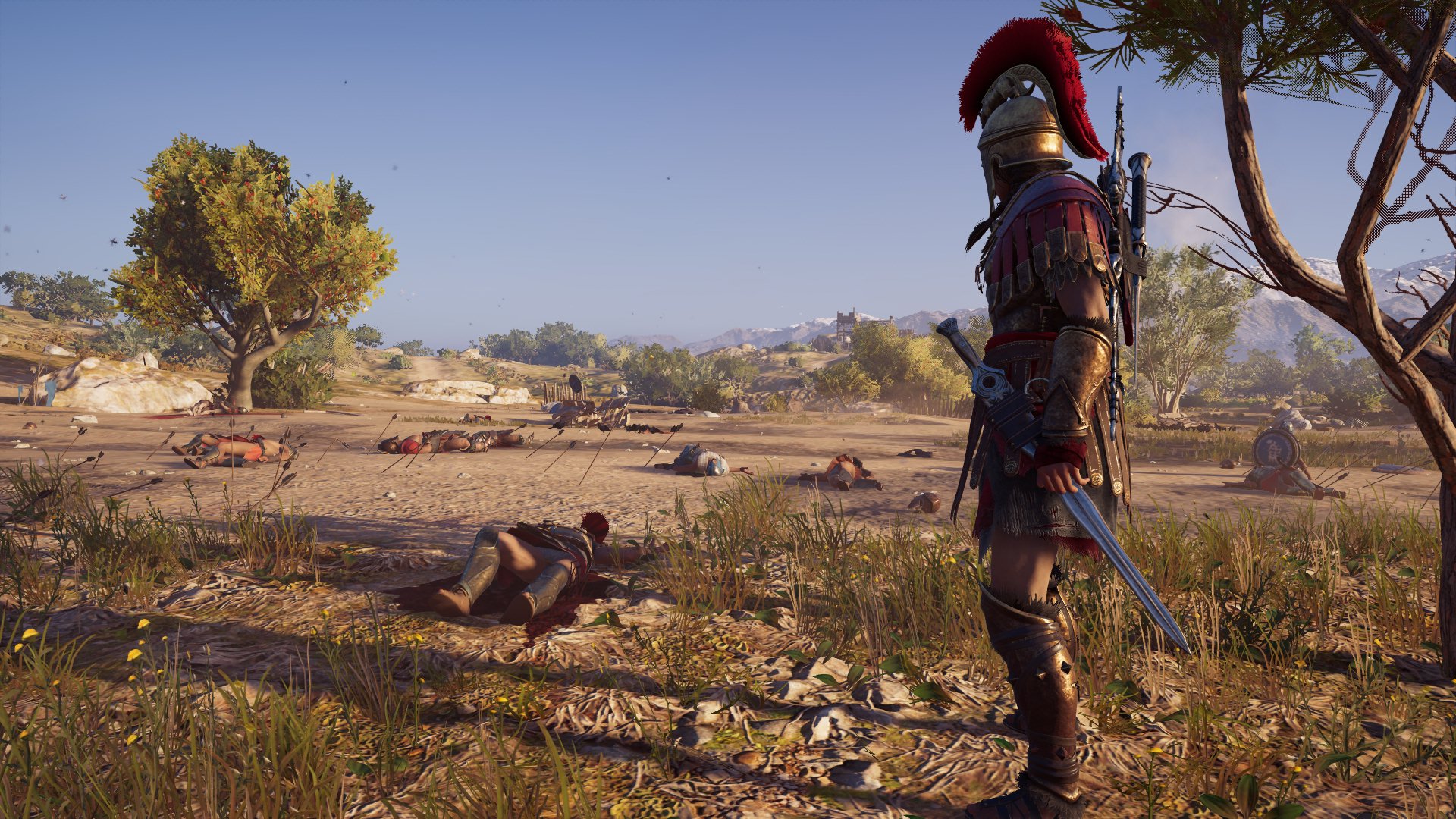
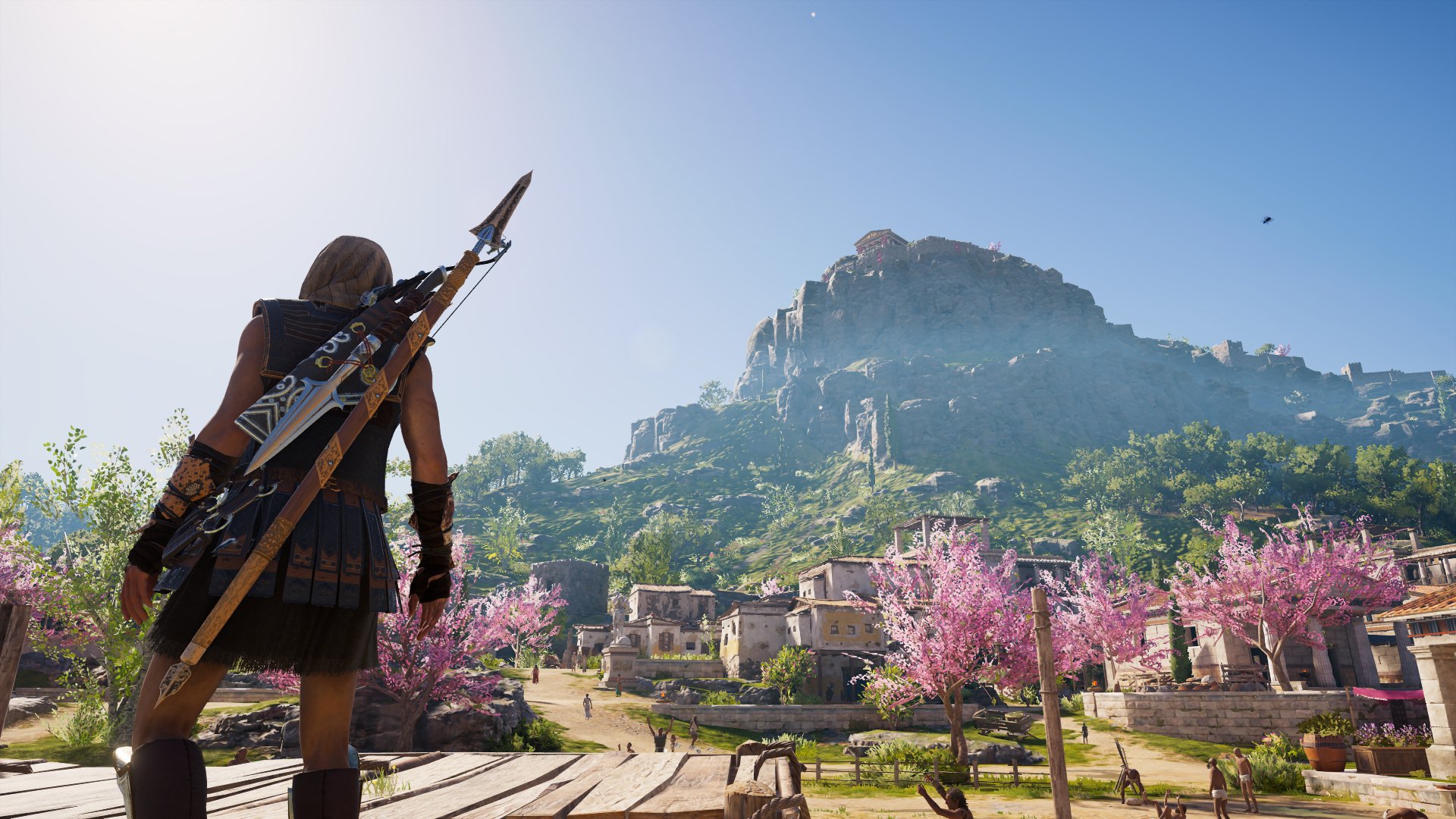
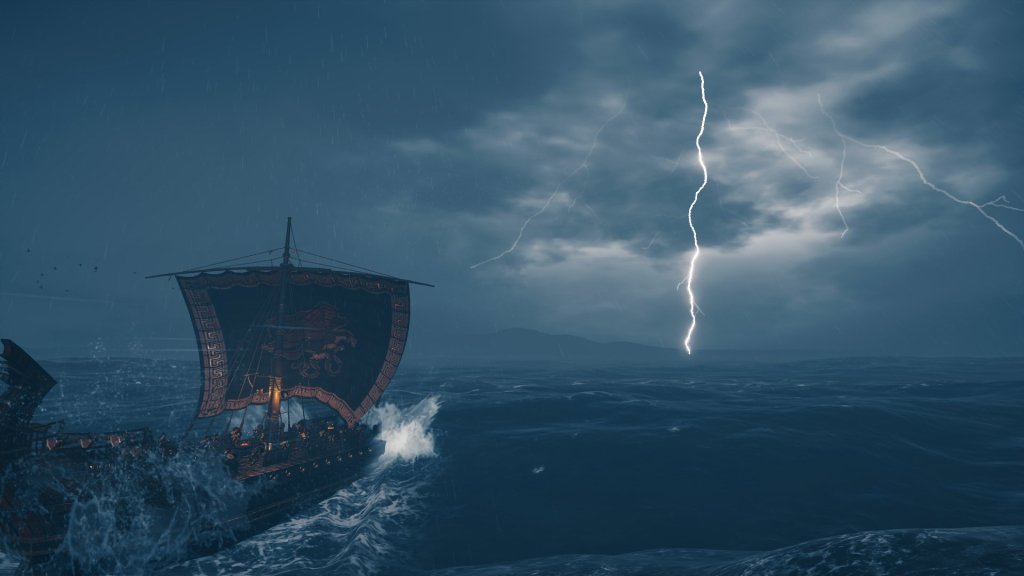
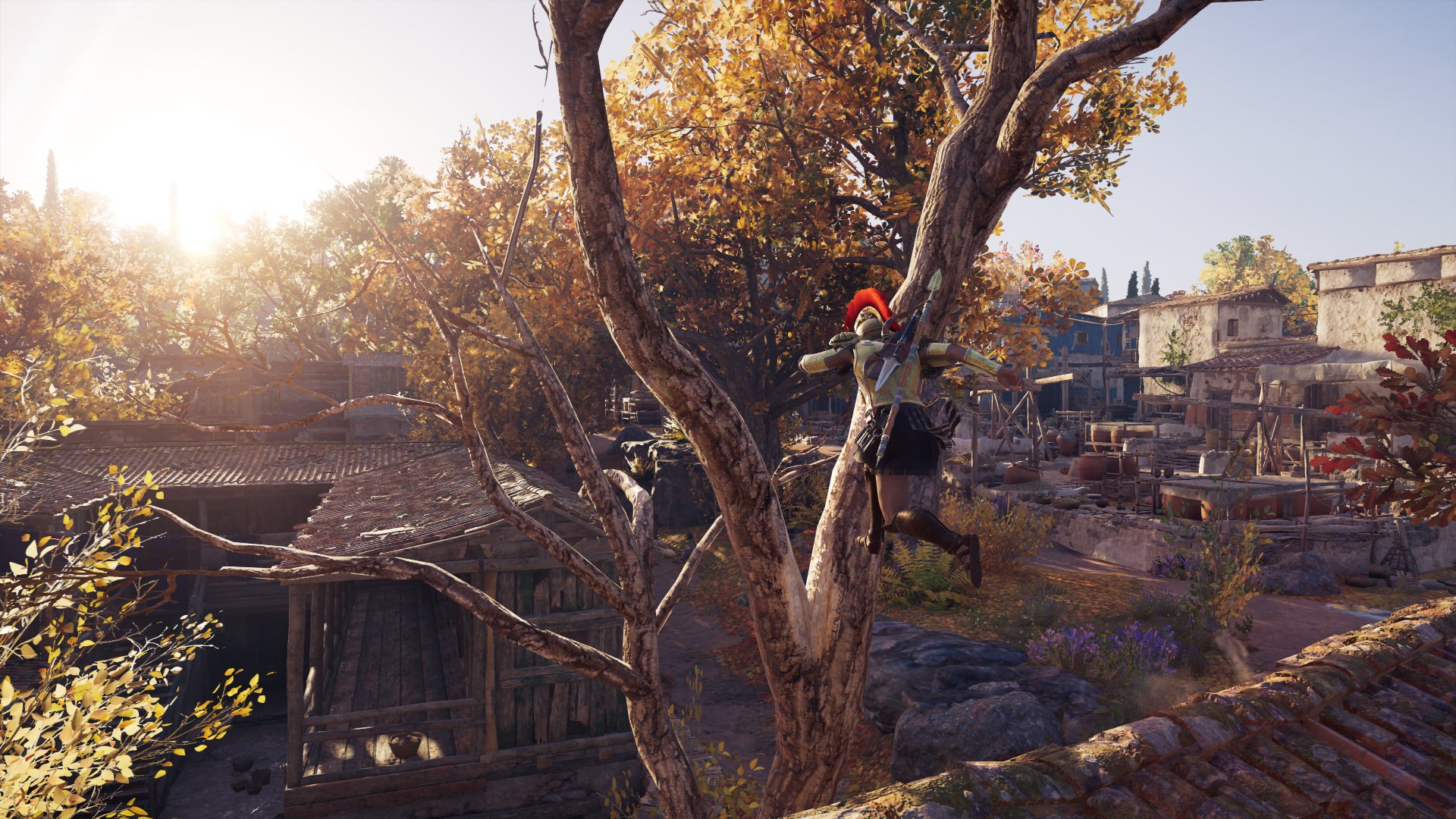
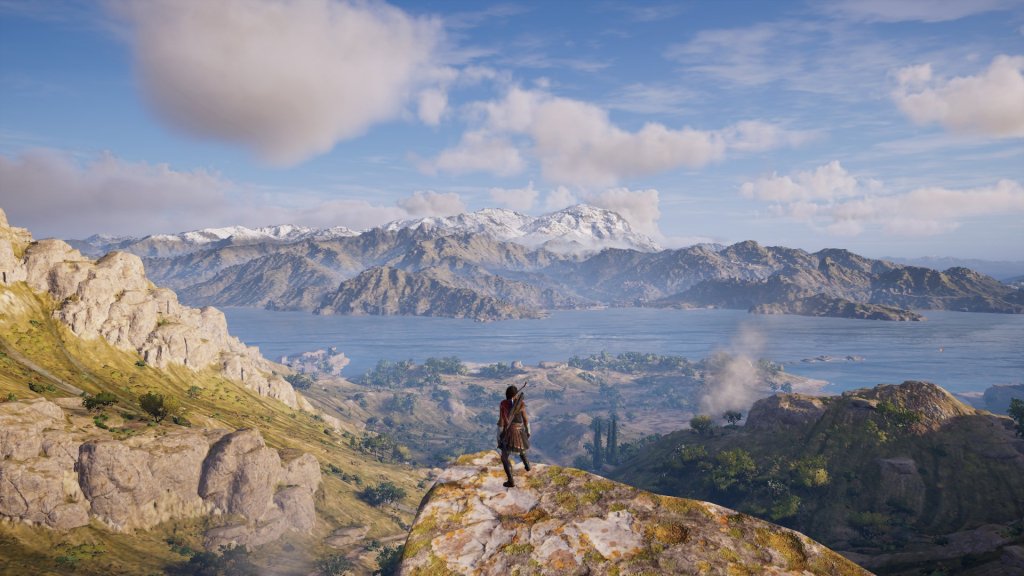
4The world of ancient Greece delivered is beyond picturesque. Bustling cities, curious caves, turquoise lagoons – anyone who wishes to simply set off in a direction in the name of adventure will not be disappointed. I’ve never taken so many screenshots. A lot of effort has been put into this aspect of the game, and I would encourage people to explore it, though perhaps not as the game would instruct them to.
5The game’s kryptonite is the gameplay loop used to ‘discover’. I will go into extensive detail on this in a separate piece, but simply put the player spends more time interacting with the HUD than the world, which is especially sad to see considering how incredible this world really is. Here is how it works: setting a marker via a menu, allowing the game to take you to the marker, panning the camera to tighten a disk, running towards a new marker, then performing the activity. It is far too easy to go into autopilot and completely disconnect from the world and events. As soon as I became comfortable with how the game worked, I opted out of every HUD element I could, and simply explored on my own – if my target was to the North of a mountain, I would simply travel North of the mountain and find them ‘properly’, instead of playing a disc minigame, then blindly chasing a marker without paying attention to my surroundings. When I did this, I had far more fun, but it would be unfair to score the game by this playstyle, since one must explicitly neglect instructions to experience it.
Additionally, immersion is diminished by the fact that combat rarely makes you feel powerful, or in danger – you are relatively weak when it comes to offence, but also near indestructible, which means the player feels neither powerful or stressed in battle – either of these emotions could really elevate our ability to share the emotions of the protagonist.
This game is held back by things the team should not struggle to fix, making me immeasurably excited for the future of the series. Even now, however, whilst Odyssey has some damning flaws, they are outshined by true brilliance. This game offers a compelling blend of the best features from other single player games, and deserves to be celebrated for that.
(The implementation of microtransactions appears to be awful, but I never found a need for them)
Not only is A Way Out of a very high quality when held to the standards of other games, but, as it was designed from the ground up to be played by two, it actually offers this level of quality within its co-op – this is key considering most co-op experiences available are essentially secondary features offering only a shell of their main game – A Way Out is a very enjoyable, complete game, for two players.
Story concept1: 8
Story execution2: 8
Immersion through gameplay3: 8
Gameplay4: 7
World5: 1
1&2 The game features strong writing with multiple points of emotional poignancy. There are some “that’s odd” evoking blips, which do detract from this, however as it hits all but one of the important notes well, and the missed one becomes apparent far too late to ruin the most of it, the experience is absolutely worthwhile.
The development of character backstories felt formulaic, largely because the plot forced them to be addressed within a slightly unbelievable timeframe.
3 The gameplay forces excessive coordination and dependance on your partner, which lends itself to the core idea of Leo and Vincent establishing trust very well. As a tool to accentuate character traits, however, it falls a little short, as player choice took priority over characters acting as is more natural to themselves (for example we get to choose who shoots, and who drives, etc.). Player convenience was prioritised over character development – this is not a bad decision, just a noteworthy one.
4 There are very strong and novel co-op gameplay mechanics at the start of the game. Towards the end, these are to some extent replaced with driving and shooting set pieces which work, but aren’t quite as endearing, as they are far more generic, have a reduced focus on co-op, and have been done better elsewhere. I found this to be especially the case with the shooting parts. Unconventional and intuitive camera usage adds a sense of spectacle throughout.
5This game is a short linear experience, and is all about the characters. A single setpiece at a campfire captures the same sense of wonder more commonplace in other games, but it never does much to even feign to the player that ongoings are organic, meaning those seeking breathtaking exploration should look elsewhere.
God of War does almost everything almost perfectly. A strong story, with strong gameplay, within an especially strong world, with the only glaring issue being the way certain level design strategies would break my immersion. The game has undeniable flaws, yet they are sparse, and so heavily outweighed by what it gets right, that there’s no reason not to play it.
Story1: 9.5
Story execution2: 8.5
Immersion through gameplay3: 5
Satisfaction through gameplay4: 8.5
World5: 10
Spoilers
1A thematically rich journey with protagonist development providing emotional notes, and a supporting cast who interlace that emotion with humour and new ideas. Contradictory characters Kratos and Atreus are bound together by a shared loss, and mould each other – as Atreus learns to kill, to be brave, and to be disciplined, Kratos learns to empathise, to be a father, and to laugh (a little). The supportive cast add new flavours to the primary arcs seen in the protagonists, with smaller arcs exploring interesting concepts, such as Mimir, a character damned for allowing his morality to interfere with his career.
2Kratos is the strongest character here (literally), and the supportive cast are phenomenally executed too. Atreus was the weak point – he feels too generic, with his defining characteristics not spanning far beyond the fact that he is a child in a harsh world, and his development suffers from disjointedness and pacing issues. For example, having Atreus going through an egotistical phase post-learning he was a god took so little time from outburst to resolution, without either transitions actually being perceivable to the player, that they never got to breathe, and never felt natural to me.
I was growing a tad bored of Kratos and Atreus before ‘head’ injected an influx of backstory and humour to the dialogue. This established a far better system where the duo’s interactions were spaced around Mimir’s well written humour, and story enriching tales, sparing the backbone of the story from otherwise feeling overused – this shows that the duo are not as strong as their obvious inspiration (Joel and Ellie, LoU), yet despite not drawing the same absurdly powerful emotional responses, they do have various strong moments, and are far beyond average. My last gripe here is the facial expressions, they simply didn’t seem human enough to me at certain key story beats, most notably Freya’s during the Baldur fight: The scene was such that her face had to convey a torrent of despair, and I didn’t really feel it.
3The way the gameplay broke immersion is where the game failed for me. Firstly, the positives. Game language did well to emphasise Kratos’ strength, for example, where most games emphasise the physical strain of climbing and the likes, Kratos effortlessly mantles walls one handed. The ease with which he performs these difficult feats throughout moment to moment gameplay fantastically articulates his power. The control scheme, whilst unconventional, worked well – the abrupt R1 bumper fits the sharp strikes far better than the conventional softer square button. Furthermore, I actually felt the vibrations through the controller fit very well in this game, which is a minor plus. So, what’s my big gripe? There is a sort of ‘plot hole’ in the level design which regularly rears its head: Kratos is constantly established as absurdly strong and durable, shown as able to jump down ten meters without flinching, for example, but then other ten meter drops are supposed to be read as ‘out of bounds’ by the player whilst exploring. Another example is the flying boat in Helheim: the bow is supposed to be out of bounds to the player, yet the only obstacle enforcing this is a small ledge – because so many boundaries wouldn’t be obstacles for Kratos, they feel more like invisible walls than natural barriers, breaking the immersion as instead of thinking ‘no, Kratos couldn’t possibly go this way’, I thought ‘the developers put an invisible wall here, to direct me the other way’. It is perhaps notable that someone not applying an intentionally critical eye to this will likely notice it far less.
4Gameplay is absolutely satisfying. You will feel your skill develop as you play, with boss fights being the pinnacle of this. The lack of foe diversity has been a problem for some players, though I found purposefully experimenting with the three combat styles (Leviathan Axe, Shield, Blades of Chaos) and special attack types to entirely alleviate this – the tools available can keep things fresh, if you force yourself to use them, so whilst it’s not perfect that the player has to act to solve the problem, it’s good that the solution is present. Camera boundaries were frustrating to me also – not the biggest issue, but one that showed up throughout, and is therefore noteworthy nonetheless.
5The Norse world is a brilliant one, providing both spectacle and story bolstering. A contained example I will use is the fallen giant – it commands an awe inspiring sense of scale, whilst also being a representation of a strand of the story. I may be biased here, as this was all novel to me, since I am not well versed in Norse mythology, regardless I found it fantastic, especially for its ability to resonate with the lore and story at almost every instance.
A single number cannot accurately convey the worth of a game to everyone with an interest in playing it. Different people seek different things from these games, and whilst so many offer an experience worthy of a conventional perfect score, they would still be the wrong choice for some players. A prime example of this is ‘The Last of Us’ – a game so great at storytelling and immersion that it’s mediocre gameplay is concealed beneath almost exclusively flawless scores. Make no mistake – this game deserves the highest praise, yet a single score is still not capable of accurately conveying its value, because there are people focused on rich and rewarding gameplay far beyond anything else, and those people should be aware that that is not what this game has to offer, and therefore is no ten out of ten experience for them. With that in mind, here are my areas of focus:
Story concept: Is the concept an emotionally or thematically compelling one (or both)?
Story execution: Does the experience hit the emotional notes it strived for, and effectively cover it’s themes?
Immersion through gameplay: Do the gameplay mechanics fortify the story, or undermine and contradict it?
Satisfaction through gameplay: Is the gameplay fun? Does it develop such that it stays fun throughout?
World: Do open world games capture that sense of exploration? Does the world bolster any other aspects of the experience?
It is important to consider something here: I don’t expect any game to be perfect in every outlined capacity, and a strong score in just a few will make it a worthwhile experience for those who seek what it offers.
Returning to The Last of Us can demonstrate this. For me, The Last of Us earns a perfect score in at least three areas (Story concept, execution, and immersion through gameplay), but falls far short in one (satisfaction through gameplay). This doesn’t mean the game is no longer worthwhile, as for most players, despite its objectively lackluster gameplay, it’s a phenomenal game: I simply believe it is important that those who have a strong emphasis on gameplay are aware that the game doesn’t fulfill that aspect to the same extent. After all, we all know that one guy who skips all the cutscenes.
The first game built something beautiful, and, as if scared of being judged for relying on that, the second strays about as far away from it as possible. There is a world within which they could’ve pulled this off, but they haven’t, which makes this overly ambitious leap into new territory feel nothing short of disrespectful to the masterpiece that came before.
Story concept: 4 Story execution: 5
Immersion through gameplay: 9 (If played non-lethally, those nonchalently killing will experience dissonance with the themes of the story).
Satisfaction through gameplay: 8
World: 9.5
— Spoilers—
The biggest point of contention is the way we play as Abby. It epitomises the exact reckless ambition that has undermined the sequel. The plan is clear – have the player’s sympathies switch from Ellie to Abby*, in one part, such that when we return to the standoff, we’re suddenly bashing ourselves for being so biased. The problem is that this failed, not just for me, but for almost everyone who played the game – showing us that Abby had friendships to lose and a motive to kill is no revelation, since both have already been demonstrated in her introduction, where she interacts with Owen and insinuates that Joel should know who she is, meaning this drawn-out stretch of gameplay does little to progress her character. So what are we left with? Our most beloved character is being held at gunpoint, whilst we’re stuck playing as someone who we cannot emotionally or morally identify with in regard to the core issue. Emotionally, we’re too invested in what Joel and Ellie had. Morally, whilst she shows signs of guilt, the truth of Abby’s character the game never seems to face is the fact that the cycle of violence we’re consistently positioned against is on her: it was with Abby that the objective became to kill, rather than to save, so Joel might’ve killed more people, and even thrown away a chance at saving the world, but his focus was on saving his daughter-figure, and there was no way he wasn’t going to do that after everything that happened through the first game. Abby’s focus was rather to avenge her father, despite this resulting in her killing a figure identical to her father – it might make a point, but it’s not one which makes Abby deserving of the empathy the game seems to expect from us.
The objective moral disparity between Ellie and Abby is fleshed out further following the main review.
*If the general narrative structure isn’t proof enough, the fact that we play as Abbie rather than Ellie when they fight makes it very clear that our allegiance is expected to have shifted.
If Joel is to be removed, and the game is to live up to its predecessor, he needs worthy replacements. Ellie and Dina’s relationship is clearly meant to fill the void, and for the most part it is executed quite well: Eugene’s ‘farm’, the dance, and the ‘Take on me’ scenes are all strong, and yet because they are in place of Joel, rather than alongside him, they have to build more of a connection than the whole fourteen hours did in the first game to feel satisfactory, which again speaks for the impossibility of what this game tried to do. When Dina left Ellie in the epilogue, I felt almost nothing, despite the fact that it was clearly meant to be impactful (it is implemented such that it works as another ‘revenj baad’ device). Whilst you could argue that since Ellie’s drive for her actions comes from Joel his part is far more substantial than I suggest, the fact that the drama of their relationship is not known to the player throughout the journey means that whilst it may be the case for the character, we never really feel it. For the player, this information is injected in bursts for effective emotional impact, long after it could’ve heightened our alignment with the present journey. So despite the father-daughter relationship leaving the game early, and taking a backseat to the other themes and characters, it remains by far the strongest part of the experience, which surely signifies failure.
To summarise, there is a lot of good here, but it is rendered futile, because whilst the game can command emotion, it disposes of it’s greatest asset in a gamble that feels careless and disrespectful, never comes close to matching that asset, and then expects us to empathise with the character responsible, despite providing them with inadequate rationale.
— things worthy of addressing —
An idea that has been pushed – most notably by ‘Girlfriend reviews’ on youtube – is the idea that our feelings towards Abby are dependant on our subjective ability to see beyond otherness – the idea that the more rational players will find their hatred dissipates as parallels are drawn with Ellie, and we realise that they are identical characters. The issue with that is that whilst Abby and Ellie are constantly compared through their shared love of nature exhibits, among other traits, they are not actually moral parallels:
Abby sees that Joel killed to save his daughter, and decides to hunt him. When she is successful, Ellie sees that Abby killed to avenge, and attempts to repay this. The point is, Abby wished death upon someone whose focus was to save another, whilst Ellie wished death upon someone whose focus was to avenge. This doesn’t make Ellie’s revenge right, but it does make it objectively more reasonable.
Abby chose to torture, not just kill. At first glance this could be attributed to the fact that Joel potentially damned humanity, however that doesn’t actually work: Joel and Abby’s father are identical , because they are willing to dismiss wider humanity to save their family (the surgeon insinuates without ambiguity that he would not sacrifice Abby for a vaccine). With this in mind, Abby cannot seek to avenge her father, and punish someone for making a decision she knew her father would make simultaeneously. Ellie torturing Nora is then used to mirror this, except later dialogue explains that Ellie tortured for information, which is clearly better than torturing for purpose of wallowing in another’s pain.
Abby’s determination to kill has lasted for five years, meaning she should be beyond the point where recency should sway her to be overly impulsive – whilst Ellie scrambles for revenge in a frantic effort to feel she has done justice, Abby spent years thinking this through before killing, so even in spite of the psychological turmoil should’ve had a much greater understanding of the potential repercussions).
Ellie killing Abby’s friends loses weight when we consider the fact that, every time, she approached them for information, and then they forced her hand – Nora, Owen and Mel all escalate the situations such that only one party can survive, so Ellie was choosing to survive, not to murder, once again making her more amenable. (It is notable that I played the game non-lethally everywhere possible, which avoided the ludonarrative dissonance experienced by many others in this regard). Whilst this was likely done to villify the cycle of violence instead of the characters, the fact that Abby didn’t have this same lack of control over her kills separates the women.
Many suggest that we are not supposed to have a revolutionary change of heart to favour Abby (which would be quite impressive if they had managed it), that we’re not supposed to take her side, and that the story is solely about revenge cycles, at least up to the absolute end of Seattle. If this is the case, I truly believe said story is even worse: as a concept, taking away things we love to fuel a revenge cycle narrative, without the intention of making any profound or meaningful points, means the writers simply chose to deliver an unpleasant experience, in the place of a pleasant one, without making it worthwhile – I could be biased, but I simply don’t see anyone contesting the idea that revenge is bad, or that empathy is good – in this scenario, the game is an unpleasant process to prove two plus two equals four.
The gameplay was very good – the general critique it has received is that it hasn’t changed much, but I simply don’t take issue with this. It’s brutal, it emphasises the scarcity of supplies, and it successfully creates suspense when intended. I also believe the improved graphics do a lot for the gameplay: when the goal is to rub your face in horrific things, a seven-year step forward in graphical fidelity does a lot. It’s perfect to play second-fiddle to the story.
Likewise, the acting is flawless.
I played the game one day after replaying the original, having avoided all spoilers. I gave it the benefit of the doubt after they took away Joel, and even when they made Abby the playable character, because those decisions did not stop the game from potentially being great.
I was browsing Amazon the other day, denying offers to ‘join Prime’ with more resilience than I had ever shown prior in life, when they suggested I buy a defibrillator – a purchase I immediately dismissed as stupid, then read about nonetheless, demonstrating procrastination prowess only accessible to life’s greatest losers. This is one of the many reasons my face could be used to define ‘Dull’ in the dictionary, were it not more applicable a little earlier.
My necessary research brought harrowing news: the defibrillator, an item which exists to save lives, had an average rating of one star out of five – clearly Amazon have joined the most of my acquaintances in thinking I should die. In their defence, I wouldn’t say this advertisement was a direct request for my suicide, merely a hint that if I were to collapse in my own home, Amazon would very much like there to be nothing anybody can do about it.
Maybe the algorithm has, at one with Bezos, begun lashing out after the divorce. Regardless, I will be embracing my next Prime offer in self-preservation.
(Note: There are certain contexts I have ignored in the name of simplifying the two dilemmas, as my goal is to highlight what player agency does for the game, not debate the chosen cases)
It appears clear to me that a key component of the masterpiece that is The Witcher 3, is the degree of player choice offered. To give a contained example, early in his journey, Geralt is tasked with identifying and stopping a murderer. After investigating, he realises the murderer is in fact a werewolf, who spends most of his life as a human, actively trying to contain his outbursts. This creates a dilemma – should this unfortunate soul who has no malicious intent be killed for something he cannot control, on the basis that it would save the lives of others? I chose what clearly seemed to be the lesser evil, but the key point here is that the game gives the player the choice, which does two important things for immersion.
Firstly, though Geralt is his own character, the player’s influence over his response to every moral and critical choice means we never feel estranged to him, and are fully aligned with our protagonist at all times. Due to the invariable ideological differences within a player base, only a game offering a somewhat dynamic protagonist can ensure we are fully aligned with the character, and therefore support them in everything they do. With this unwavering support for the character inevitably comes a greater investment in their success, which undeniably makes for a more immersive experience.
Second, is the way our control over situations creates a full sense of responsibility for their outcomes. At another point in the story, we are presented with a character (of sorts) who is trapped by a curse, but promises to save a group of innocents we know to be in danger if she is freed. The problem is, if we enquire as to how the character became cursed, she avoids the question and provides no satisfactory response. The dilemma here:do we release a hugely powerful and dishonest being, because she is an enemy of our enemy, and claims she will free the innocents? By killing her, I felt fully responsible for the later deaths of the innocents, who just might’ve been saved had I risked breaking the curse, in a way I simply wouldn’t have were I to watch Geralt make this decision from the back seat. Of course, the responsibility felt when making these decisions also relies on the characters involved being expertly crafted, such that you care for them, though whilst the game does this masterfully, it is not the focus of this article. Furthermore, this contained example is only the tip of the iceberg, as these choices become so much more meaningful when you are deciding the fate of primary characters within the experience.
So, to wrap up my ramble, player choice plays a key part in this being one of the best games ever made, by making us both feel fully invested in our protagonist’s success, and fully responsible for the mixed fates of those who are a part of it. This is also a fine example of how the interactive nature of video games can truly elevate them above conventional storytelling mediums.
Notable:
Admittedly, other games feature player choice, yet I feel the positive effects are multiplied exponentially by the near-unrivaled writing and depth of The Witcher 3, making it the perfect game to focus on.
Regarding the first point made, I realise many texts intend for you to be repelled by the protagonist’s actions or nature at times, and that this is integral to their story, however I would argue just as many wish for the reader to be aligned with their protagonist, and fail due to an inevitable difference of outlook/ideology within at least one segment of an audience.


 Gamedy